
Ukrainian banks have been actively increasing lending for over two years, but not everyone can get a loan. Financial institutions carefully assess clients’ income and solvency, their credit history, debt burden, and for businesses – financial stability.
So, who are banks more willing to lend to today, and who finds it harder to get financing? The editorial team of PSM analyzed the current data from the NBU, banks, and government programs for 2025-2026 and created a profile of the borrower that banks most often say “yes” to.

Photo: pexels.com
Banks have been increasing lending for the second year in a row
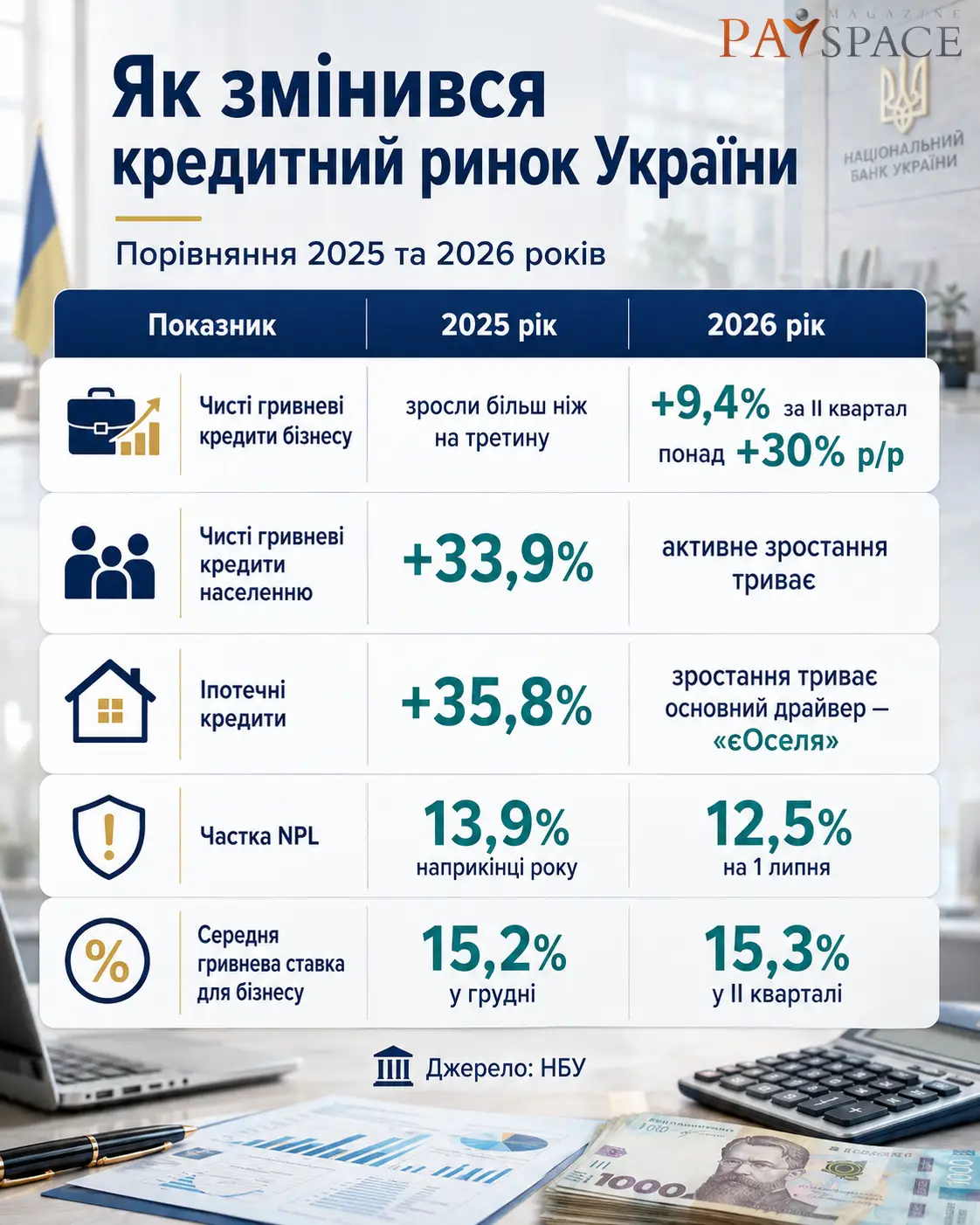
By the end of 2025, net hryvnia loans to businesses and individuals increased by more than a third. In the retail segment, the growth of net hryvnia loans was 33.9%, and mortgage loans – 35.8%. The state program “єОселя” remained the main driver of mortgages, as before.
In 2026, credit expansion continued. According to the NBU, in the second quarter, the net hryvnia credit portfolio of businesses increased by 9.4% quarterly, while in the first quarter, the growth was 6.3%. In annual terms, the growth exceeded 30%.
Moreover, banks are increasing lending not by deteriorating the quality of their portfolios. As of July 1, 2026, the share of non-performing loans in the banking system decreased to 12.5% – the lowest level in almost 17 years. For individuals, the figure was 10.1%, and for businesses – 15%.
It is important to consider that the decrease in the NPL share is due not only to the emergence of new quality loans but also to the restructuring and write-off of old problem debts. In particular, as the NBU noted, at the end of 2025, state-owned banks wrote off over UAH 170 billion of old non-performing assets.
Who are banks most willing to lend to among businesses
In the corporate segment, there is no single “ideal” company size. In 2026, enterprises of various scales are increasing lending, but banks pay special attention to small and medium-sized businesses (SMEs).
According to the NBU survey for the second quarter, overall corporate lending standards have not significantly changed. At the same time, for the third quarter, banks planned to ease requirements specifically for SME loans.
Individual banks also reported an increased approval rate for SME applications, and borrowers themselves gained the opportunity to attract larger sums.
However, the mere existence of a profitable business is not enough for a bank. It is important for the lender to understand:
- what revenue and cash flow the company generates;
- how stable its business is;
- what debt burden it already has;
- why the loan funds are needed;
- from what source the enterprise will repay the loan.
This is especially true for long-term and investment financing. The longer the loan, the more uncertainty the bank takes on, so the requirements for the borrower become stricter.
SMEs are becoming one of the key clients
Conditions for small and medium-sized businesses have been gradually improving since the end of 2025. According to the NBU Survey on Bank Lending Conditions, banks have been easing credit standards for SMEs, hryvnia and short-term loans, and in some cases, collateral requirements.
One reason is the increased competition among banks for quality clients. Government and international guarantee mechanisms, which allow lending to companies lacking traditional collateral, play an additional role.
Therefore, the typical desired borrower in the SME segment is no longer necessarily a company with a large amount of real estate that can be pledged to the bank. Actual business operations, understandable cash flow, and the ability to service debt are becoming much more important.
Read also: The share of non-performing loans in banks has fallen to its lowest since 2009
Which sectors are banks lending to most actively
The sectoral structure of lending is also gradually changing.
According to NBU data for the second quarter of 2026, the fastest-growing loans were to enterprises in:
- construction;
- metallurgy;
- machine building, including the defense industry;
- manufacturing.
Moreover, lending is actively growing not only in sectors related to current consumption but also in those requiring capital investment and restoration of production capacities.
A separate direction is the defense industry and energy sector. In its review of the banking sector, the NBU notes the increasing share of loans to defense enterprises and projects for the reconstruction of the energy system.
In the second quarter, the medium-term corporate portfolio also grew noticeably: according to the regulator, loans with a repayment term of one to three years showed the fastest dynamics.
This means banks are increasingly willing to finance not only working capital but also business development.
And who are banks lending money to among individuals
The situation with individuals is somewhat more complex.
The NBU does not publish a single system-wide portrait like “the average bank borrower is a 37-year-old man with a salary of UAH 40,000.” Therefore, it would be incorrect to name the specific age, gender, or income of a typical consumer loan recipient for the entire Ukrainian market.
However, the banks’ criteria clearly show which characteristics actually influence the decision to issue a loan.
For example, PrivatBank provides cash loans to clients aged 21 to 65. The available amount is calculated individually and depends, among other things, on credit history, financial activity, existing debt obligations, and the overall assessment of the client’s solvency. Having another loan does not automatically mean refusal.
At Oschadbank, the age range for cash loans is also 21-65 years. The bank requires income documents for the last six months, and the available amount depends on the level of official salary.
Thus, in mass consumer lending, banks primarily assess the client’s financial behavior – income stability, credit history, and current debt burden.
The best chances are for individuals with stable regular income, no significant defaults in their credit history, and no excessive current debt burden.
What a bank checks before issuing a loan
The precise scoring models of banks are internal information and vary between institutions. However, the basic principles are similar.
- Income. Not only its size but also its regularity is important. The bank must see that after paying current expenses and existing loans, the client will have enough money left for the new payment.
- Credit history. Delays, previous loans, and repayment discipline directly affect the risk assessment. PrivatBank, for example, separately explains the role of credit history in evaluating a client.
- Current debt burden. Another loan will not necessarily lead to refusal if the income is sufficient to service all obligations. PrivatBank explicitly states that it assesses the client’s current burden.
- Financial activity. It is important for the bank to understand how clear and predictable the client’s behavior is.
- Collateral. For consumer loans, collateral is often not required. For mortgages and large business loans, it carries significantly more weight.
Read popular: How much banks have increased lending in 2026 — AUB
Consumer loans remain the basis of the retail market
Unsecured loans traditionally dominate retail lending. According to the NBU’s review for the second quarter of 2026, this structure is maintained.
Banks continue to compete for solvent clients. According to the NBU survey for the second quarter, they have somewhat eased lending standards for mortgages and consumer loans, and the household application approval rate has increased. Financial institutions also reported a decrease in rates.
However, unsecured loans for individuals remain significantly more expensive than corporate financing.
For comparison, according to NBU data, the average hryvnia interest rate for businesses in the second quarter was 15.3% per annum, and private banks with foreign capital lent at an average of 13.5%.
For specific retail products, the rate is much higher. For example, under the current conditions of PrivatBank’s “Cash Loan,” the interest rate is 34% per annum on the outstanding balance, and the real annual interest rate can reach 40.48% depending on the loan term.
For comparison, at Oschadbank, a standard cash loan has an interest rate of 36% to 48% per annum depending on the loan amount. There is no loan origination fee.
In monobank, after the grace period ends, the base rate on the credit limit on the card is 3.1% per month, or 37.2% nominal per annum. However, the real annual interest rate, which includes the full cost of credit according to the established methodology, is 44.26%.
In Raiffeisen Bank, for cash loans for salary cardholders, the interest rate ranges from 29.9% to 51.9% per annum, and the real annual interest rate, depending on the amount, loan term, and insurance, can range from 34.9% to 72.2%.
Where to see the real age of a borrower
The most comprehensive open demographic profile in Ukraine is provided by the state mortgage program “єОселя.”
However, its data cannot be automatically applied to the entire credit market: the program has preferential categories and its own selection criteria, so its audience differs significantly from clients of credit cards or regular cash loans.
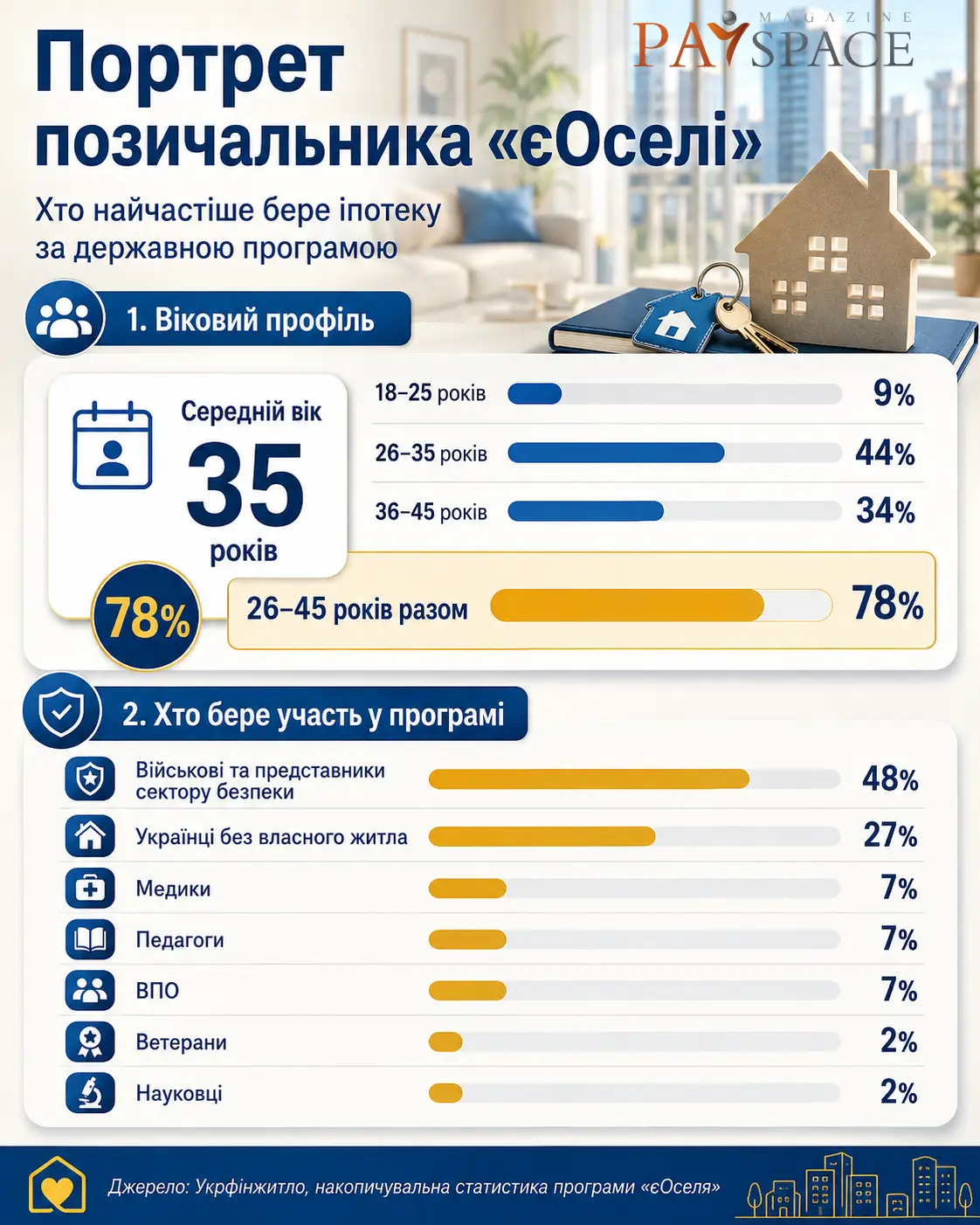
According to “Ukrfinzhytlo,” the average age of an “єОселя” borrower is 35 years. The largest group is Ukrainians aged 26–35, accounting for 44% of borrowers. Another 34% are people aged 36-45. Thus, 78% of recipients of such mortgage loans are between 26 and 45 years old.
Regarding gender, there is no current distribution for the entire program in open statistics. However, data from Oschadbank – one of the largest participants in “єОселя” – provides an indication.
As of October 2025, the average age of its borrowers under the program was 34 years, with 44% of clients aged 26-35. Men constituted 65%, and women – 35%. At the same time, over 56% of the bank’s borrowers were military personnel and representatives of law enforcement agencies.
Therefore, these figures do not indicate that banks are generally more willing to lend to men. The significant gender imbalance is primarily due to the structure of the program itself.
Read also: Banks of Ukraine are increasing lending at record rates — NBU
So, who is the borrower that a bank is willing to say “yes” to
If we set aside the specific requirements of individual products, the profile of an individual whom a Ukrainian bank is willing to lend to in 2026 looks quite simple.
It is a person of working age with stable regular income, a normal credit history, a moderate debt burden, and financial behavior that is clear to the bank.
For mortgages, the requirements are higher: one must have sufficient funds for the down payment and prove the ability to service the debt for many years.
In the corporate segment, the desired borrower is a financially stable business with transparent reporting, predictable cash flow, and a clear understanding of why it needs the loan. The size of the enterprise is gradually becoming less decisive: banks are increasingly competing for SMEs.
Therefore, the main change in 2025–2026 is not simply that banks have started issuing more loans. Banks have developed a greater appetite for lending, and competition for solvent borrowers is intensifying. At the same time, money is primarily received by those clients whose ability to repay the loan the bank can predict with sufficient confidence.
Explore other popular materials:
Citizens of which countries have opened the most businesses in Ukraine in 2026
New requirements for fiscal receipts for businesses are being prepared in Ukraine
A business incubator for youth has been launched in Ukraine