
The cost of electricity can significantly increase in the summer due to the constant operation of air conditioning, and in the winter due to water heaters, heaters, and electric heating. One way to reduce bills without sacrificing usual comfort is to switch to a two-zone electricity metering system.
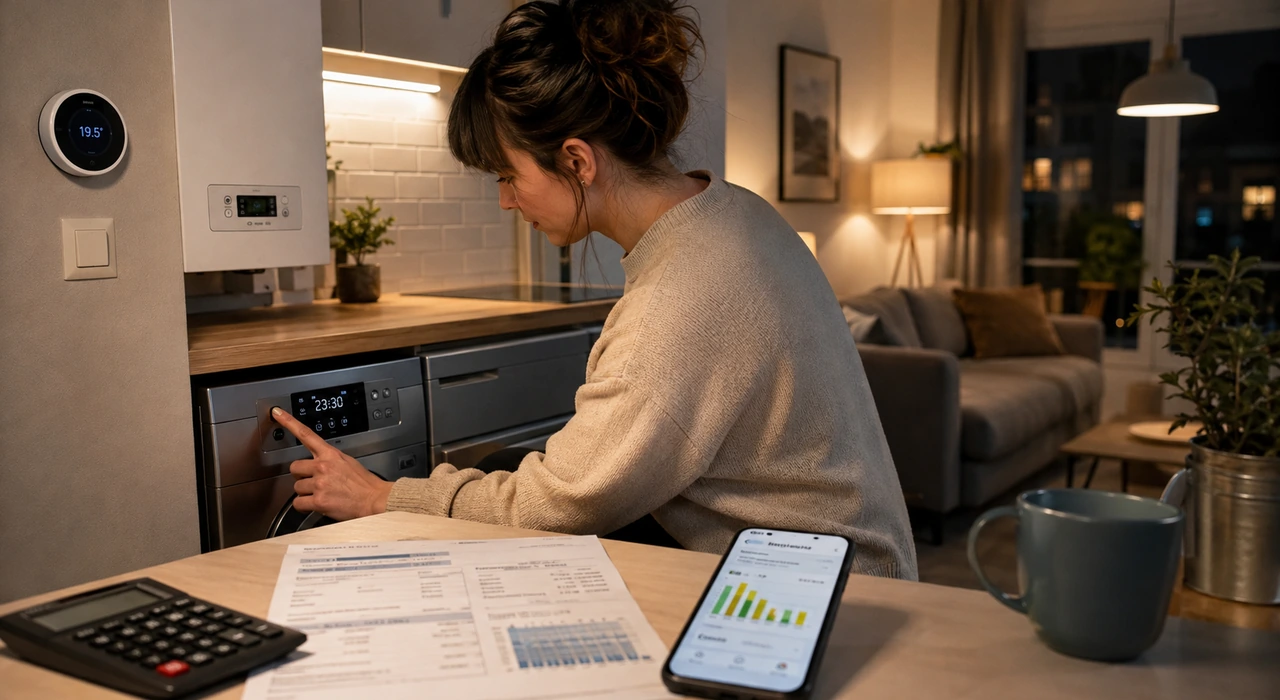
Photo: chatgpt.com
How Savings Are Formed
A two-zone meter separately records electricity consumption during the day and at night. From 11:00 PM to 7:00 AM, electricity is charged at a lower rate – twice as cheap as during daytime hours.
Therefore, households that shift the operation of energy-intensive appliances to nighttime hours — water heaters, washing machines, dishwashers, air conditioners, or electric heating systems — achieve the greatest savings. However, reducing the entire bill by 50% is only theoretically possible if almost all consumption occurs at night. In practice, the extent of savings depends on how many household processes can be moved to the preferential period.
What Data the Meter Shows
On the display of a two-zone meter, readings typically change automatically at set intervals. The consumer can see:
- the amount of electricity consumed during the day;
- the volume of nighttime consumption;
- the total reading since the meter was installed.
Read also: Who among Ukrainians can receive assistance with utility payments
To correctly transmit the data, one must pay attention to the indices, which depend on the device model.
In GAMA meters, the day zone is indicated by code 15.8.2, night by 15.8.1, and the total reading by 15.8.0.
In NIK models, daytime consumption may be indicated by designations 1.8.2, 15.8.2, or T22, and nighttime by 1.8.1, 15.8.1, or T21. The total volume is displayed under codes 1.8.0, 15.8.0, or T2.
In MTX meters, the day is marked with index 1.8.2, night with 1.8.1, and the total reading with 1.8.0.
When to Submit Readings
The data must be submitted to the distribution system operator monthly within the established period. Before submitting, it is advisable to check if the figures correspond to the usual consumption level.
If the readings suddenly become excessively high or, conversely, unnaturally low, one should contact the energy company. The reason could be a reading error, incorrect device operation, or the need for its inspection.
Installation Costs
A two-zone meter, including programming and installation, costs on average from 3000 to 5000 UAH. The final amount depends on the device model and the network type — single-phase or three-phase.
The payback period is determined by monthly consumption and the proportion of electricity used at night. For a family consuming 200–300 kWh per month and regularly running a water heater and washing machine after 11:00 PM, the installation costs could be recouped in approximately 10–14 months. In homes with electric heating or active air conditioner use, this period may be reduced to 4–6 months.
The PSM editorial team emphasizes that a two-zone meter itself does not reduce electricity consumption. Real savings only emerge when a household changes its habits and shifts the operation of the most energy-intensive appliances to nighttime hours. Before installing the device, it is worth analyzing one’s own consumption and preliminarily calculating the possible payback period.
Explore other popular materials:
A new service for Ukrainians has been launched in Diia
Pensions and social benefits in 2027: what changes is the Cabinet preparing
How much tax did state-sector enterprises pay in the first half of 2026
Based on materials from napensii.ua.